Reusable launcher aerodynamic databases
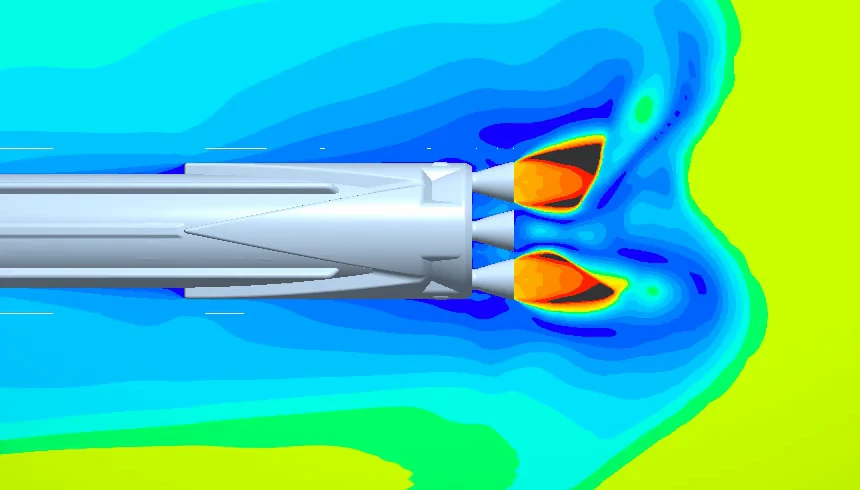
CFD support for the SALTO T3 vehicle, from aerodynamic database generation to DLR wind-tunnel campaigns and flight-condition extrapolation.
Based at EPFL Innovation Park in Lausanne, Switzerland, our specialists help international
engineering teams model fluid dynamics, thermal behaviour, and multiphysics
to support data-backed design decisions.
Resolving complex flow physics into validated, decision-ready evidence for advanced engineering teams.


CFS Engineering supports aerodynamic, aerothermal, fluid–structure interaction, and tailored CFD work for engineering decisions.
You need reliable forces, moments, stability, or performance data across configurations and operating points.
Explore the decisions we supportHeating, hot-gas physics, or thermal-protection uncertainty is constraining a re-entry or propulsion design.
Explore the decisions we supportGround tests do not cover the complete operating envelope, or the difference between test and flight conditions must be understood.
Explore the decisions we supportSeparation, wakes, buffeting, or oscillatory motion may create loads and stability behaviour that steady analysis cannot resolve.
Explore the decisions we supportFluid loading and structural deformation interact, making one-way or uncoupled assumptions unreliable.
Explore the decisions we supportA pump, biofluid, transport, smoke, or natural-convection problem needs a workflow shaped around its particular physics.
Explore the decisions we support[02]
Access a complete simulation team without the overhead of assembling one.
You work with the engineers shaping the model, running the simulations, and translating the results for the wider programme.
Selected aerospace, fluid–structure interaction, and biofluid cases connect engineering questions with CFD analysis and published references.
See more projectsCFD support for the SALTO T3 vehicle, from aerodynamic database generation to DLR wind-tunnel campaigns and flight-condition extrapolation.
Steady and unsteady CFD, wind-tunnel reconstruction, and dynamic stability evidence across the Mars entry-to-descent trajectory.
Static and dynamic fluid–structure interaction for Swiss operational conditions, including vertical-tail buffeting and coupled load generation.
Three-dimensional CFD studies of aortic-root haemodynamics and valve procedures, supported by published cardiovascular flow research.
[04]











We discuss security from the start. Together, we review access, data flows, credentials, retention, and the compute environment to match your project’s needs.
Yes. We can use a private or on-premises cluster if it has the required software, capacity, and access controls. We agree on execution, data transfers, and responsibilities before setup.
We only access what the project requires. Where possible, models, results, and supporting data stay in the agreed infrastructure. We limit access to the project team and agree on data handling and retention up front.